Selected Case Studies
I have spent my career working at the intersection of technology, operations, transformation and organisational change, often within complex, high-pressure environments where the realities on the ground matter far more than presentation slides or theoretical models.
I've seen:
-
failed transformations
-
ignored operational realities
-
M&A integration pain
-
political complexity
-
under-estimated change
-
technology decisions disconnected from operations.
£6m annual additional revenue
The situation:
Construction materials manufacturing company with significant growth objectives required market distinguishing capabilities, but was hampered by disconnected sales, unstructured fulfilment operations, significant manual work, poor data, and outdated systems.
What was done:
Identified constraints and opportunities as the baseline for defining appropriate solutions and delivery approach. Designed and delivered solutions that complement new and existing capabilities through incremental implementation to minimise operational disruption and ease adoption for both staff and customers. Solutions included AI enabled supply optimisation and automation, enabled warehouse and distribution automation, proactive customer order management, and new AI enabled omni-channel commerce and customer service.
What changed:
-
20% quicker order fulfilment, 40% lower sales friction
-
10% increase of automated repeat orders and £6million directly attributable annual additional revenue
-
£3 million Opex savings in the 1st year
.png)
.png)
£5m annual efficiencies
The situation
A national hospitality operator with 80 properties was acquired by private equity with aggressive growth expectations, planned acquisitions to scale the business, and demanding operational efficient scale. Disconnected business functions, manual processes, data gaps and limited systems prevented the business from achieving investment objectives.
What was done:
Aligned the executive team and private equity investors to establish the clear investment objectives, reassessing grandiose and speculative strategy consulting. Led the operations and technology transformation underpinned by a sensible business strategy. Focused on appropriate technology investment, (including AI enabled pricing and facilities management capabilities) and pragmatic delivery ensured minimised operational disruption.
What changed:
-
Delivered £5m annual operational efficiencies
-
Created a stable and scalable platform for future acquisitions
-
Supported £1bn exit valuation
Releasing 3% EBITDA savings
The situation:
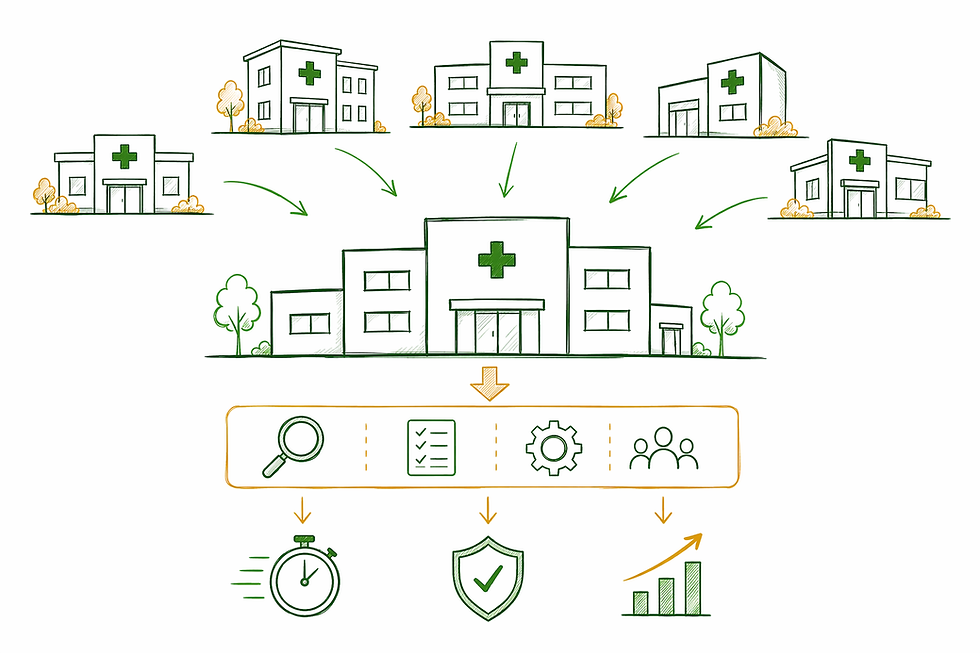
Acquisition of 14 specialised healthcare facilities with inconsistent systems and operational risk across facilities by PE backed healthcare group.
What was done
Operational, technology and compliance reviews simplified risk visibility and integration planning. I discovered that the14 healthcare facilities had mixed technology estates and various states of integration, plus mandatory dependence on 3rd party services. Individually the facilities were extremely inefficient and non-compliant; collectively they represented a critical risk to the deal.
What changed:
-
Released savings equivalent to 3% EBITDA
-
Proactive mitigation reduced operational and compliance risk
-
Established sensible business continuity plans and a compliance framework enabling execution of future integrations and creating scale
.png)
.png)
Unlocked accelerated growth from chaos
The situation
A fast-growing Apparel manufacturer and direct to consumer ecommerce company faced operational bottlenecks, high error rates, and poor customer service, largely attributed to manual work, fragmented data and poor systems; All significantly slowing growth.
What was done:
Aligned the executive team and private equity investors to establish the clear investment objectives. A rapid assessment of the business operating model, processes and current state technology followed, highlighting critical constraints, risks and unidentified opportunities. Designed a sensible fit for future architecture and delivery plan to address investment objectives and accelerated business change minimised investment required. A practical operational and technology improvement programme focused on simplification, automation and scalable processes
What changed:
-
Rapidly recovered historical operational backlog
-
Created a stronger platform for future expansion reducing errors by 40%
-
Enabled revenue growth from £10m to £30m within 18 months
-
Contained operational cost increase to only 20%
Integration reduced annual operating costs
The situation:
Four Media, SaaS, and business intelligence subsidiaries needed to be carved-out from 2 global corporates and merged to create newly combined vertical specialist entity. All had deep incumbent group operational, technical and IP integration and dependency requiring precision carve-out and pragmatic merger integration to ensure operational stability and achieve scalability.
What was done:
Integration planning aligned operations, technology and product capabilities into one operating model that enabled integration that ensured value preservation through business continuity and using appropriate technology from both entities for best fit for future operations to unlock value creations
What changed:
-
Reduced combined operating costs by £4m annually
-
Improved operational consistency
-
Enabled seamless up-sell and cross-sell accelerating value creation

.png)
Scalable platform reduced complexity
The situation:
An insurance group had acquired eight regional and vertical specialists, but delayed integration led to duplicated technology costs, missed revenue opportunities, and reduced operational effectiveness across the portfolio.
What was done:
Conducted a retrospective technology due diligence across data, technology and operations across all acquired companies. This identified significant tech debt, cyber and data risks, and scalability limitations. A practical integration approach simplified operations, aligned customer data and reduced duplicated complexity across the group
What changed:
-
Reduced operational friction cost across the portfolio by US$800k/a
-
Improved customer visibility and cross-sell opportunities
-
Created a scalable foundation for future acquisitions
Exposing an AI investment mirage
The situation:
A B2B media corporate was looking to acquire an AI platform to strengthen its B2B information services offering. The AI platform that appeared impressive on the surface but the company needed to ensure it is technically and operationally sound, and have insight on enabling wider value creation and potential synergies .
What was done:
Conducted detailed due diligence on operational processes, data, technology, cyber security and AI capability and uncovered major gaps in scalability and capability, and identified third‑party IP usage risks.
What changed:
-
Avoided a poor £50m investment
-
Improved leadership visibility of AI risk
-
Created a stronger framework for future AI acquisitions

.png)
Reduced transition timelines by 12 months
The situation
A mid-market law firm mobilised to sell a specialist division to private equity but didn’t know what the current sate capabilities were or what they needed to operate as a separate entity. They also lacked clarity on operational complexity and transition requirements and needed to align people, operation and technology.
What was done:
Conducted a full discovery of operations, technology, and client processes identified critical risks but also opportunities for operational simplification and improvement. Designed a fit for future separate architecture and roadmap and costs for carve-out readiness and transition focused on ensuring value preservation. Proactively identified where they could accelerate value creation benefits and enhance the value of the sale.
What changed:
-
Identified £2m annual operational savings
-
Reduced transition timelines by 12 months
-
Improved client and commercial team alignment, enabling scale with confidence.
Integration delivering immediate value
The situation:
A logistics services company previously acquired several businesses to create a new division, but neglected robust technology due diligence, synergy identification, and an integration strategy. This resulted in their continued independent operations creating duplicated costs, divergent processes, fragmented customer management and fulfilment.
What was done:
Did retrospective enhanced due diligence on processes, data, systems, and cyber security and identified operational limitations, system risk, and avoidable wastage. Designed the accelerated integration strategy to contain escalating value erosion, unlock synergies, and restore a clear path to value creation. Delivered an integration programme aligned operations, systems and customer data to create a more connected business.
What changed:
-
Reduced fulfilment operating costs by 60%
-
Improved customer management and created future product opportunities
-
Unlocked £2m+ revenue opportunity
-
Contained £1m duplicate technology costs

.png)
Transformation with measurable value
The situation
Retail and financial services group built up through multiple acquisitions over time and misguided technology investment. This resulted in divergent operations and customer data, and technology complexity that impeded revenue opportunities and operational effectiveness across the portfolio. EBITDA was also impacted by duplicated technology costs.
What was done:
Functioning as interim CTO to lead to lead a full transformation, I started with a comprehensive discovery on data, systems, infrastructure, cyber security, and operations to identify risk and formulate a sensible programme to deliver operational stability and scalability. Working in partnership with business change, I designed and delivered an integrated technology landscape that is fit for future, achieving standardisation, simplification and cost effective.
What changed:
-
Technology Opex reduced by 40%
-
Increased £3m+ revenue through unified customer approach
-
Unified customer and transaction data unlock AI opportunities for further consumer propositions